
Anyone who has been involved in sport has had moments when everything just clicks. In basketball, the ball goes in no matter where you shoot from. In football, every feint works, every sprint is in the right place. Tim Grover, in his book “Relentless: From Good to Great to Unstoppable,” explains “the zone” as follows:
“Anyone who has experienced the awesome power of the Zone will tell you it is a place of deep calm. It is not relaxed or peaceful — this is not yoga, but intense focus. And once you are there, you have no fear, no worries, no emotions. You are doing what you came to do, and nothing can touch you.”
So, how do you enter that same “zone” as an athlete? Sport psychology uses visualization methods for this purpose. And if you think the site has changed its focus and we are moving into the esoteric, I want to present some research showing that mental training can influence physical performance. There is an established connection between mental rehearsals and actual movement in terms of physiological variables.
The theory of visualization

Motor imagery (the scientific definition of visualization) is a mental simulation of a specific movement without actually performing the designated task (Guillot et al., 2007). Psychoneuromuscular theory suggests that the electromyographic activity (EMG) of a muscle during actual movement will be the same during motor visualization (Guillot et al., 2007). Along with the innervation of electrical activity, it is noted that the Golgi tendon organ is also stimulated, eliciting a magnitude of neuromuscular activity. To test this theory, Guillot and colleagues (2007) examined the impact of motor imagery on muscle contractions during muscular responses. EMG recorded the values of heavy dumbbell lifts during actual and mentally simulated movements. The values were comparable, indicating that the amount of electrical activity in the working muscle was similar during actual and mentally simulated movements. As a result, mental imagery can be a useful method for improving performance without the potential risk of overtraining.
Beyond examining actual movement, research shows that other factors must be taken into account, such as the environment and real-time movement (Weinberg & Gould, 2010). This level of mental preparation would allow the athlete to practically reproduce their effort and have stronger control over their emotional state, eliminating the possibility of any distraction.
From theory to the philosophy of visualization
Does this mean that we can “imagine” a workout and achieve real results? No, of course not. Visualization is a complementary training practice whose purpose is to prepare the athlete for the mental challenges they will face during the actual performance of their sport. Even elite athletes at the highest level have found themselves in situations where one point or one miss can turn the entire match around. What about amateurs?
Visualization is the sporting expression of one of my favorite Stoic exercises, premeditatio malorum — anticipating the worst, experiencing and processing it in our minds so that we are prepared for it if it truly happens. This goes against the ingrained idea of not thinking about bad things, of avoiding them almost religiously, but in reality it is the prepared mind that helps us not freeze in critical situations.
From philosophy to the practice of visualization
Visualization, like any skill, must be trained — otherwise it cannot be developed. Fortunately, research in the field has identified the key factors that help with its proper execution.
A key factor for successful visualization is “vividness” (Weinberg & Gould, 2010). The more vivid the imagery, the more it allows the athlete to believe that the movement is not new to them. The autonomic nervous system, the electromyography of muscle contractions, and the neuromuscular activity of the body are all influenced by imagery. Building this vivid image can affect all these variables, making the mentally rehearsed movement feel as though it has happened before.
It is important for the mental picture to be as detailed as possible. This requires you to detach from your daily routine in a setting that does not distract you. This could mean closing your eyes and listening to music, or going into your room with the lights off and lying on your bed. Whichever scenario allows you to keep your mind completely still and quiet, without any disturbances, is the best one. Once you reach this state, all you need to do is engage in vivid visualization, which should end with success (a new personal record, a made basket, a scored or saved goal, etc.).
Rather than a conclusion, I want to go into even more detail and show what a visualization session might look like in two of my favorite sports — powerlifting and mountain running.
Visualization in strength sports
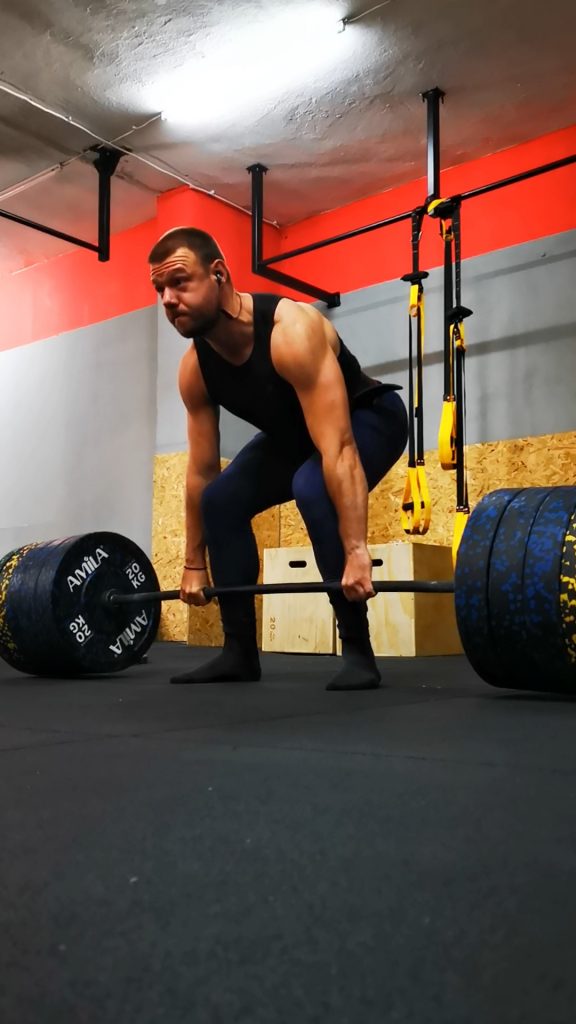
What would a visualization session look like when we are talking about performing a maximum deadlift? Alongside a properly structured program that culminates in a maximum attempt, every day the athlete trains, they should dedicate about 10-20 minutes to visualization. This works especially well in a place that is secluded and dark, and if music conducive to a meditative state can be played — even better. The athlete should picture the environment in which they will perform the attempt as vividly as possible. This includes not just the visual elements, but smells, sounds, and the people around them. They should even imagine the feel of their feet on the ground. Then it is good to imagine how the barbell will feel in their hands. The more details they add, the more realistic it becomes, and the body will react to this kind of engagement as if it has “already happened.” Then the mindset becomes: if you have “done something before,” why can’t it be done again? Mental imagery and visualization give you this type of confidence!
Visualization in endurance sports

I have not forgotten those who are involved in endurance sports. Here, visualization can be a bit more complex, because a mountain marathon can last up to 12 hours. In these cases, beyond imagining the environment, it is good for the athlete to try to picture the hardest moments. How they will manage the climbs, imagining the wind rushing in their ears during the descents. It is hard to visualize a 12-hour marathon, but on the other hand, we have the advantage that the mind has no sense of time. We can speed up and slow down, allowing us to focus as effectively as possible.
References:
- Guillot, A., Lebon, F., Rouffet, D., Champely, S., Doyon, J., & Collet, C. (2007). Muscular responses during motor imagery as a function of muscle contraction types. International Journal Of Psychophysiology: Official Journal Of The International Organization Of Psychophysiology, 66(1), 18-27.
- Weinberg, R, & Gould, D. (2010). Foundations of sport and exercise psychology (5th ed.). Champaign: Il: Human Kinetics.
- Whelan, J. P., Epkins, C. C., & Meyers, A. W. (1990). Arousal interventions for athletic performance: Influence of mental preparation and competitive experience. Anxiety.
If you want to work with a sport psychologist specializing in visualization and mental techniques — learn more about my approach or book a free consultation.